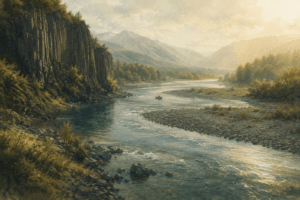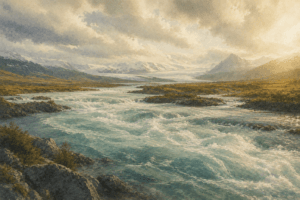
Almost a century ago, an Englishman named John Goodall tipped a consignment of brown trout eggs into two small streams at the bottom of the world. He could not have known he was creating the greatest sea-trout river on earth. The Río Grande of Tierra del Fuego — a big, cold, wind-hammered river running across the Fuegian steppe to the South Atlantic — now carries a run of more than seventy thousand sea-run brown trout a season, with an average fish around twelve pounds and giants past thirty. For many anglers, a week here is the pinnacle of a fly-fishing life.
The Río Grande at a glance
- Where: northern Tierra del Fuego, Argentina — steppe and estancia country, not the national park.
- Length: about 240 km in all; it rises in Chilean Tierra del Fuego (roughly 140 km) and runs some 100 km through Argentina.
- Mouth: the South Atlantic, at the city of Río Grande.
- The fish: sea-run brown trout — the largest in the world — averaging ~12 lb, with fish over 20 lb every week and 30 lb possible.
- Run: more than 70,000 sea trout enter the river each season.
- Season: early January to late April; prime weeks around 15 January to 15 March.
- Rules: strict catch-and-release since 1986; single barbless hooks; access is lodge-controlled.
Geography: a river that crosses a border
The Río Grande is the most important river of the Tierra del Fuego archipelago. It rises in the Chilean, western part of the great island and flows generally eastward — the first ~140 km through Chile, the final ~100 km across the Argentine steppe — before emptying into the South Atlantic at the Argentine city of Río Grande. This is open, treeless, wind-swept country: no forests, no mountains at the water’s edge, just a powerful river winding through the grasslands to the sea.
It is worth clearing up a common confusion: the Río Grande is not inside Tierra del Fuego National Park. That park lies far to the south-west, near Ushuaia. The famous sea-trout river runs through the private estancias of the island’s north — names like Estancia María Behety and Estancia Despedida — and it is on those estancias, through their lodges, that almost all of the fishing takes place.
How the world’s greatest sea-trout river was born
The Río Grande’s sea trout are not native — they are the result of one man’s experiment. In 1935 John Goodall, an English settler, arranged for about 100,000 brown trout eggs to be shipped from Puerto Montt, Chile, and stocked two tributaries of the Río Grande. Around sixty thousand survived. Finding limited food in the river, the young trout dropped down to the sea — and there, in the rich, barely-fished South Atlantic, they thrived, growing fast and returning to the river as sea-run browns. From that accidental beginning came the fishery that defines the species today. Read our full guide to sea-run brown trout in Argentina.
The fishery: the largest sea trout on earth
What the Río Grande offers is size and numbers found nowhere else. Fish average around 12 pounds — a fish of a lifetime on most rivers — and every week of the season produces trout over 20 pounds, with 30-pound-class fish landed each year. They arrive chrome-bright and astonishingly strong, fresh from the ocean, and because the run is so large the fishing is remarkably consistent for water of this quality. Even a “small” Río Grande fish is a bright, hard-running six- or eight-pounder.
The lodges and the beats
The Argentine Río Grande is fished almost entirely on booked lodge weeks. The historic estancias and lodges — among them Estancia María Behety, Estancia Despedida, Kau Tapen and Villa María — control long private beats, typically 10 to 15 km each, with dozens of named pools and runs; together the main operations hold more than 100 pools across some 50 km of the river’s most productive water. Anglers rotate through these beats, fished morning and evening (the low-light hours are prime), which is a large part of why the fishing stays so consistent — and why weeks book months, sometimes years, ahead.
Season and conditions
The sea-trout season runs from early January to late April — the austral summer and autumn — with the prime weeks generally falling between 15 January and 15 March, when the greatest numbers of fresh fish are in the river. The Río Grande is famous for its relentless wind, which is simply part of the experience; anglers who can cast in a blow, and fish through the evening, catch the most.
How the Río Grande is fished
Sea-trout fishing here has more in common with steelhead and Atlantic-salmon fishing than with trout fishing:
- Two-handed rods: spey and switch rods (about 7- to 9-weight) give the reach and line control to fish the big pools in the Fuegian wind.
- The swing: the classic method — casting across and down and swinging a fly on a sink-tip through the holding water, waiting for the heavy pull of a take.
- Sink-tips and nymphing: a range of sinking leaders gets the fly to the fish, and heavy rubber-leg nymphs under an indicator are deadly in bright, low water.
Proven flies include black and purple leeches and Woolly Buggers, the famous EMB (“Every Meat Ball”) leech, rubber-leg nymphs such as the Girdle Bug and Yuk Bug, and tube patterns like the Sunray Shadow.
Regulations and conservation
The Río Grande is a conservation success story. Strict catch-and-release was introduced on the Argentine side in 1986, and the average size of the fish has climbed ever since. The rules today are simple and strict: single barbless hooks, all fish released, and access managed through the estancias and lodges that hold the water. From the 2026 season the Chilean side of the river is also moving to catch-and-release with single barbless hooks. Handle these fish — the product of years at sea and multiple spawning runs — gently, and keep them in the water. For licences and the wider permit system, see our guide to fishing licences in Argentina.
Getting there
The city of Río Grande has its own airport, with flights connecting through Buenos Aires and Ushuaia; the lodges are a short drive from town or from Río Grande airport. Most anglers arrive on a pre-arranged lodge transfer as part of a booked week. It is a long way to the end of the world — but for the fish that wait there, few journeys are more worthwhile.
Frequently asked questions about the Río Grande
Where is the Río Grande in Tierra del Fuego?
It is in the north of Isla Grande de Tierra del Fuego. It rises in the Chilean part of the island and flows east across the Argentine steppe to the South Atlantic at the city of Río Grande. It is estancia country — not the national park, which lies far to the south-west near Ushuaia.
Why is the Río Grande the best sea-trout river in the world?
It carries a run of more than 70,000 sea-run brown trout each season, the fish average around 12 lb, and 20- and 30-pound trout are landed regularly — the largest sea-run browns anywhere. Decades of catch-and-release since 1986 have kept the average size climbing.
How did sea trout get into the Río Grande?
They are not native. In 1935 John Goodall stocked two tributaries with brown trout eggs from Chile; the fish went to sea, became anadromous, and thrived in the rich South Atlantic — creating the fishery that defines sea-run brown trout today.
How long is the Río Grande?
About 240 km in total — roughly 140 km in Chile and 100 km in Argentina — making it the most important river in the Tierra del Fuego archipelago.
Do you need a lodge to fish the Río Grande?
Effectively yes. The best water is controlled by estancias and lodges — María Behety, Despedida, Kau Tapen, Villa María and others — that manage private beats and rotate anglers, so it is almost always fished on a booked lodge week planned well ahead.
When is the best time to fish the Río Grande?
Early January to late April, with the prime weeks around 15 January to 15 March, when the most fresh fish are in the river.
Plan your Río Grande trip
A week on the Río Grande, chasing the largest sea-run brown trout on the planet, is the summit of Argentine fly fishing — and the best weeks fill far in advance. Tell us your dates, budget and experience, and we’ll match you with the Tierra del Fuego lodges that fit.