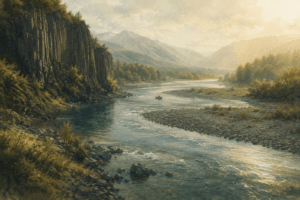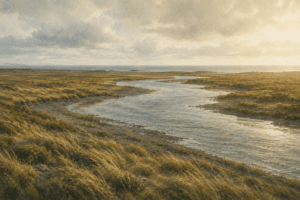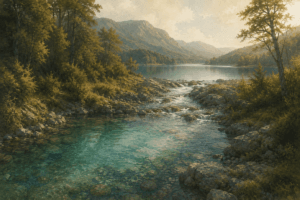
The Santa Cruz is a river of superlatives: a vast, milky-turquoise torrent of glacier melt pouring out of Lago Argentino and carving 385 kilometres across the deep-south steppe to the Atlantic. It is one of the last great free-flowing rivers of Patagonia — and, improbably, the home of the largest king salmon on earth. Fish that push past fifty pounds, and touch ninety, run up this immense water each summer. To fish it is to chase a genuine giant on a river that feels like the end of the map.
The Santa Cruz at a glance
- Where: Santa Cruz province, deep southern Patagonia, between El Calafate and the Atlantic.
- Source: the outlet of Lago Argentino — glacier melt from the icefields of Los Glaciares National Park.
- Length: 385 km (up to 543 km measured from its farthest source through Lago Viedma and the Río La Leona).
- Flow: an average of about 790 m³/s — a huge, powerful river.
- The fish: chinook (king) salmon — the largest race in the world, consistently over 50 lb, with a record of 91 lb.
- Season: roughly January to April for kings.
- Access: remote and outfitter-based, from El Calafate and the estancias.
A river of ice and steppe
The Santa Cruz is fed by the largest concentration of glaciers in Argentina. Its ultimate headwaters gather in Lago Viedma, flow through the Río La Leona into Lago Argentino, and from that lake’s eastern end the Santa Cruz proper begins — carrying the pale, sediment-rich meltwater of glaciers such as Perito Moreno, Upsala and Viedma. From there it runs east across open, treeless steppe, at an average of nearly 800 cubic metres per second, until it reaches the Atlantic near the towns of Piedrabuena and Puerto Santa Cruz, where it forms a wide estuary.
On the national-park question: the river’s source region — Lago Argentino and the glacier-fed lakes — lies within Los Glaciares National Park, and the small tributary Río Caterina also flows within the park. The main river, however, runs largely through provincial steppe and estancia land on its way to the sea.
The largest king salmon on earth
The Santa Cruz’s king salmon are one of the great accidents of modern fishing. Chinook (king) salmon from Washington State were introduced to fish-farming projects in Chile in the 1970s; the fish escaped, spread south through the Strait of Magellan and north along the Atlantic coast, and colonised the great southern rivers — including the Santa Cruz. Here they grow to a size seen nowhere else: this is widely considered the largest race of wild king salmon in the world today, with fish consistently over 50 pounds and a lodge record of 91 pounds. Some believe the next world-record chinook will come from this river. Read our full guide to chinook (king) salmon in Argentina.
The season and the fishing
The king run shapes the season. It opens around January, when the fish school up near the shore along an arm of Lago Argentino, at the very head of the river. As summer turns to autumn and the run pushes on into March, the fishing follows the salmon upstream and into the smaller, clearer tributary Río Caterina — where it becomes exclusively fly fishing. On the big main river, this is heavy-tackle work: powerful two-handed rods, deep sink-tips and large flies to reach fish holding in that enormous, glacier-cold flow.
Flies and how it’s fished
Kings do not feed in fresh water, so flies are chosen to provoke an aggressive, territorial grab through size, movement and colour:
- Intruders and big articulated streamers that push water, in chartreuse, pink, orange and black.
- Heavy tube flies ridden on deep sink-tips to reach fish in the powerful current.
- Strong tackle throughout: 8- to 10-weight two-handed rods, heavy leaders, and reels with a serious drag — a fresh Santa Cruz king will test everything you own.
Access, estancias and getting there
This is remote, expedition-style fishing. Most anglers reach the Santa Cruz through licensed outfitters and estancias — Estancia Cristina and specialist king-salmon operators among them — based out of El Calafate, the gateway town near Lago Argentino, which has an airport with connections through Buenos Aires. Trips are almost always booked programmes, combining the fishing with the raw grandeur of the southern icefields.
A free river under threat
The Santa Cruz is one of the last major rivers in Patagonia to run undammed to the sea — but that status has been contested. Two large hydroelectric dams, Cóndor Cliff and La Barrancosa, have been under construction on its middle course, a project that would flood tens of thousands of hectares of steppe and fundamentally change the river’s flow and its fisheries. The scheme has been the subject of long environmental and political controversy; anyone planning a trip should check the river’s current status, as its future — and the future of its salmon run — is not yet settled.
Frequently asked questions about the Santa Cruz River
Where does the Río Santa Cruz start and end?
It begins at the eastern outlet of Lago Argentino — glacier melt from Los Glaciares National Park — and flows 385 km east across the Santa Cruz steppe to the Atlantic near Piedrabuena and Puerto Santa Cruz. Measured from its farthest source through Lago Viedma, it runs about 543 km.
Why is the Santa Cruz famous for king salmon?
It holds what is widely considered the largest race of wild king (chinook) salmon in the world — fish consistently over 50 lb, with a record of 91 lb. Some believe the next world-record chinook will come from this river.
How did king salmon get into the Santa Cruz?
They descend from Washington-State chinook introduced to Chilean fish farms in the 1970s. Escaped fish spread through the Strait of Magellan and colonised the great southern rivers, including the Santa Cruz, forming a self-sustaining run.
Is the Santa Cruz in a national park?
Its source — Lago Argentino and the glacier-fed lakes — and the tributary Río Caterina lie within Los Glaciares National Park. The main river itself runs largely through provincial steppe and estancia land to the Atlantic.
When is the best time to fish for king salmon on the Santa Cruz?
Roughly January to April. The season opens in January with fish schooled near Lago Argentino and moves upstream into the Río Caterina as autumn approaches, when it becomes exclusively fly fishing.
Are there dams on the Santa Cruz?
Two hydroelectric dams, Cóndor Cliff and La Barrancosa, have been under construction on the middle river — a long-controversial project that would change its flow and fisheries. Check the river’s current status when planning a trip.
Plan your Santa Cruz River trip
Chasing the largest king salmon on the planet on a wild glacial river is one of fly fishing’s true frontier adventures. Tell us your dates, budget and experience, and we’ll connect you with the outfitters who run these remote southern waters.